There is a question that tells you, within about ten seconds of walking in, what kind of Japanese market you are standing in. It is not what is on the tables. It is: who was allowed to put a table here?
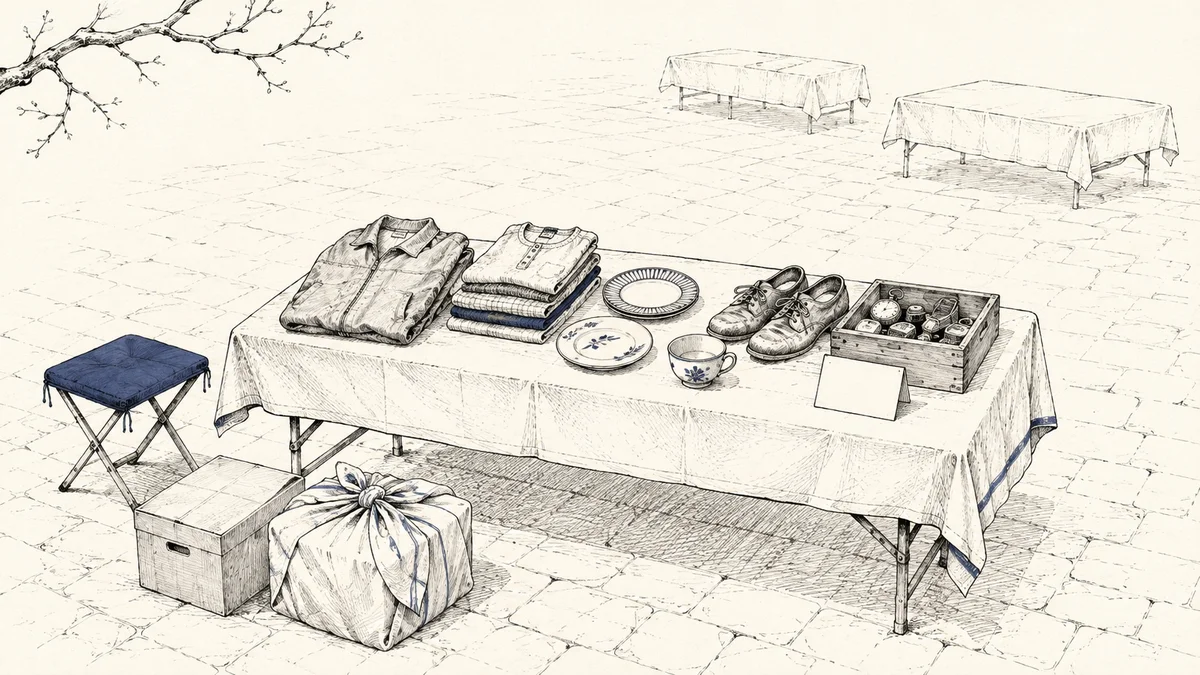
Ask it, and a country of markets that looks like one blurred thing — stalls, tarpaulins, folding tables, someone's grandmother's plates — comes apart into five quite different worlds. In one, the seller is a household emptying a cupboard and is forbidden by the organiser's own rules from reselling anything they bought that morning. In another, the seller holds a licence issued under a national law about dealing in used goods, wears a name badge, and can be told by the committee to correct how they have described an object's age. Those two people are not doing the same job, and you are not doing the same thing when you buy from them.
I used to mind the till in a secondhand shop, which mostly taught me to read the ticket before the garment. A price tag is a small confession: it tells you who wrote it, what they think they have, and how badly they want it gone. So I have spent this week reading the rules that organisers publish for their own sellers, which is an odd way to plan a day out and a very good way to understand one. What follows is drawn from those pages — the organisers' own words, opened on 5 September 2026 — rather than from atmosphere. Atmosphere is the one thing you will not need help finding.
1. The citizens' market: a household, clearing out
The association that runs flea markets in park after park across Tokyo did not start as a business. The Recycle Undō Shimin no Kai — the Citizens' Recycling Movement Association — records on its own history page that it was formed in 1974, and describes itself as a body organised after the 1973 oil shock as a movement to re-examine the ways of thinking and living that put first an economic activity which wastes the earth's environment and resources
. It held its first flea market at Yoyogi Park in 1980. Everything about how its markets run still follows from that sentence.
Sellers must apply and pay in advance; there is no turning up on the day. A pitch is 3m × 2m if you carry your goods in, 6m × 3m if you sell out of your car, at most venues. Food and drink cannot be sold at an ordinary pitch. Membership is tiered, and the tiers are the interesting part: a trial membership costs nothing in annual fees, an amateur or art membership is ¥2,000 a year, a professional membership ¥8,000 — and the association tells people selling mainly ordinary household unwanted goods
to pick the trial or amateur tier. If you make things yourself, you are directed to an "art pitch", and at some venues those pitches are gathered together into an area the association calls, wonderfully, the Art Liberated Zone.
Then there is the rule I keep thinking about. Selling, at your own pitch, something you bought from another seller during the same market is — in the FAQ's own wording — absolutely prohibited
. In 2026 the association also told its sellers, in writing, that copyright-infringing goods, counterfeits and high-priced resale items are banned.
Read those two rules next to each other and you can see what the organisers are protecting. The association does not shut traders out — there is a professional tier, and companies are told to phone the venue staff before applying — but it sorts the tiers so that the ordinary pitch is the household's pitch, and it removes the one move that would turn a pitch into a shop: buying on site to sell on site. What you get from that is a price that is not the result of a valuation. It is the result of someone deciding a thing should leave the house. This is the market where you are most likely to be talking to somebody who does not sell for a living — and, for the same reason, the market where you should least expect the seller to know what they have.
Its venues are ordinary places, which is the point: Ajinomoto Stadium, Kinshi Park, Setagaya Park, Kiba Park, Hikarigaoka Park, the Tokyo International Forum, and Fussa Base Side Street — the street beside the American air base, where the association's day is billed specifically as a used-clothing and antiques market. If you are here for clothes rather than crockery, that last one is the address to write down.
2. The antique market: a licensed trade, working outdoors
Walk from Tokyo Station for five minutes, or Yurakuchō Station for one, and twice a month the plaza at the Tokyo International Forum fills with something structurally different. The Ōedo Antique Market describes itself as an outdoor antique market held twice monthly at which more than 250 Japanese and Western antique shops from all over the country take part each time
. Admission is free. It runs 9:00–16:00. It is cancelled if it rains. In August it does not run at all, because of the heat.
Its sellers are not clearing out a cupboard. The market's rules require them to comply with the Antiques Dealing Act, to carry an antique dealer's licence with the itinerant-trading clause included
, and to display the antique dealer's sign somewhere visible at the pitch. Stalls are open to anyone who intends to sell antiques and who has passed this market's screening
. Sellers must give correct explanation and display of an item's period, condition (repairs, damage and so on), and authenticity
— and if the committee thinks a description is wrong, the seller follows the committee's instruction. Everyone working a pitch wears a market-issued seller ID where you can see it.
The organisers publish their pitch fees, which is the fastest way to understand the difference in seriousness. At the Tokyo International Forum a half pitch, 1.8m square, costs ¥8,000; a full pitch ¥12,000; a pitch and a half ¥14,000; a double ¥17,000. Nobody pays that to clear out a wardrobe.
What this means for you is practical, and the market says it plainly. Complaints about goods are settled directly with the shop concerned
— the office cannot help you if you do not know which shop you bought from, so its advice to visitors is to check the shop's name when you buy or leave a purchase behind. Cards: It depends on the dealer. Please ask directly. (Unfortunately there is not so many.)
Bags: there is no left luggage; use the coin lockers in the building. And before you photograph anyone or anyone's stall, the market asks you to get their consent first, which is worth knowing before you lift a phone over a table of somebody's stock.
The organisers also say, on their own front page, that the market has been chosen by the American travel magazine Condé Nast Traveler for a list of things to do in Tokyo. I could not open the magazine's own article, so I pass that along as the organiser's claim rather than as a fact about the magazine.
3. The temple market: the same date, month after month
The two markets most worth building a trip around are not really markets. They are religious observances that grew one.
At Tō-ji in Kyoto, a memorial rite for Kūkai — the monk the temple's own pages call, affectionately, Kōbō-san — is held in the Miedō hall at ten in the morning on the 21st of every month. The temple's own account of how the market appeared is a small masterpiece of cause and effect: people came for the rite, so a teahouse opened to serve them, then dumplings, then firewood and charcoal, then pots and pans. Then, some seven hundred years.
Today the temple writes that on the 21st its grounds fill with close to a thousand stalls
, and that the day has come to be known simply as Kōbō-san's day. The temple's English page states the schedule in one line: Kobo-ichi market, On the 21st of every month.
A smaller bric-à-brac market, Garakuta-ichi, runs on the first Sunday.
In the north-west of the same city, Kitano Tenmangū holds its fair on the 25th. The date is not arbitrary either: the shrine explains that the 25th derives from the birth date of Sugawara no Michizane, 25 June, and the date of his death, 25 February. Stallholders line the approach all day, and after sunset the grounds are lit — 350 stone lanterns and 250 hanging lanterns, by the shrine's own count. Two of those twelve days are much bigger than the rest. At the first fair of the year on 25 January, the shrine records around a thousand stalls inside and outside the grounds and attendance of about 150,000 people. At the last, on 25 December, the shrine lists what the extra stalls are selling, and the list is the reason this article exists: plants, antiques, used clothing and garments, alongside the ornamental kale and New Year decorations and salted salmon.
You will not find a curator here. You will find, on a fixed date that has not moved in centuries, a thousand people who have decided that this is where their things go. It is also the only kind of market on this list where the shopping is the by-product and not the point, and it changes how the day feels: nobody is running an event around you.
4. The ticketed one: a market that has become a festival
Of the five, Tokyo Nomi no Ichi is the one that has been designed most deliberately. Its organiser, Tegamisha, describes it as a festival fusing shopping, hands-on experiences and live music, running since it began in 2012, and describes its stock as antiques selected by the shopkeepers' eye
alongside crafts, Scandinavian homeware, flowers and food. There are artists' live sets and performances. The autumn 2026 edition is announced for 31 October and 1, 2 and 3 November, 9:30–16:30, at Shōwa Kinen Park in Tachikawa. Advance tickets are sold online. The same organiser has also run a Kansai edition at Expo ’70 Commemorative Park in Suita and a Hokkaidō edition at Naganuma; both of those are listed on the same page as finished, so the autumn Tokyo dates are the ones to plan around.
The paid ticket is not a detail; it is the whole social contract. At Tō-ji you are a visitor to a temple that happens to have a market. Here you have bought a day out, and the market owes you a day out. Both are good. They are not interchangeable, and if you have one weekend in Japan and want to meet ordinary people rather than attend something excellent, this is not the one.
5. The handmade market: nothing here is old
The fifth kind reverses the antique market's logic completely. At a tezukuri-ichi — a handmade market — the qualification for a pitch is not a licence to sell other people's past but the fact that you made the thing yourself this year.
These run on fixed monthly dates too, and the pattern is the same as the temple fairs, often because they are temple fairs: the directory run by Kyoto Noren Co., Ltd. under the name Monozukuri Ōendan lists Hyakumanben Tezukuri-ichi in Kyoto on the 15th of each month, a makers' market at a shrine in Chōfu, in western Tokyo, on the first Sunday, Oyakushi-san no Tezukuri-ichi in Miyagi on the 8th, and Higashi-Betsuin's morning market in Aichi on the 8th and the 18th. The company says it built the site because it wants to support Japanese making — it manufactures noren curtains, furoshiki cloths and banners in Kyoto — which is a more honest reason to run a listings site than most listings sites give.
For anyone whose interest in Japanese clothes runs toward how they are made rather than who is wearing them, this is the branch to follow, and it connects to the makers we keep on this site's craft shelf.
The part that is not shopping
Everything above is really one argument: the rules decide who you meet.
At the citizens' markets you meet households, because the organiser has been arranging it that way since 1974 — a tier that costs a once-a-year seller nothing, a professional tier priced four times higher, and a ban on the one move that would turn a pitch into a shop. At the antique market you meet a trade, with badges and a licensing statute behind it, and the conversation you can have is about an object's period and condition, because the seller is obliged to be able to have it. At the temple fairs you meet a neighbourhood on a date it has kept for centuries. None of that requires you to speak much Japanese. A price written on paper, a hand held up with five fingers, a nod at a jacket, the seller turning it inside out to show you the lining without being asked — this is a form of conversation that survives having no words in common, and it is the reason a flea market is a better first Sunday in Japan than most things on a list of attractions.
The old shop habit that still helps here is to look at how the thing has been laid out before looking at the thing. A garment folded so the label shows, a coat hung rather than piled, a plate turned face up: somebody has thought about you. That is a seller you can ask questions of, in any number of words. What I would not do is arrive with a script. I have read a lot of advice about how to behave at these markets, almost none of which appears anywhere in what the organisers themselves publish — including the confident business about haggling, which no official page here mentions at all. So I am not going to tell you the local custom for it, because I could not find a primary source that states one. What one organiser does ask for is small and specific. The Ōedo market asks visitors to get someone's consent before photographing them, to check the shop's name when they buy, and to settle any problem with the seller rather than the office. Those are that market's rules and I am not going to pretend they are national etiquette — but the first of them costs nothing to extend to every stall you point a phone at.
What the weak yen does and does not change
A visitor arriving now converts money on favourable terms, and it would be silly to pretend that does not make a day like this more fun. But it is worth being precise about what you are getting, because the two halves of the market react to your currency very differently.
The dealers' side is a trade. Prices there reflect what an object is worth to somebody who knows what it is, and the same object in the same condition would not be cheap in Paris or Portland either. What the exchange rate buys you at the Ōedo market is room to consider the good one rather than the damaged one.
The households' side does not know you are coming. A pitch at a citizens' market is priced by a person who wants the coat to belong to somebody else by the time the market packs up, and that price was set against nothing except the coat. That is the origin of the actual bargain, and it is also why it is not owed to you. Turn up expecting cheapness as a right and you will be the tourist in the story. Turn up expecting to spend an unhurried morning looking at what a Japanese household actually owned, and the cheap thing will find you.
One more piece of arithmetic that has nothing to do with currency: rain. The two organisers whose weather rules we could read are unsentimental about it. The Ōedo market is cancelled outright when it rains. The citizens' association posts cancellations from seven o'clock on the morning of the event, and tells its sellers plainly that if no notice has appeared by seven, the market is on. We did not find written rain policies for the temple fairs or the handmade markets, so do not assume they have none. Check at seven, not at nine.
Where to look the dates up
Because most of these markets run on fixed monthly dates rather than published seasons, the useful skill is not searching but knowing which four pages to keep.
- Recycle Undō Shimin no Kai — the citizens’ association’s own site, with its venue list, schedule and the seven o’clock rain notice. Japanese only. Note the address: the older
recycler.orgstill works but now redirects here permanently, so bookmarkwww2.recycler.jp. - Ōedo Antique Market (English page) — dates for the coming months, opening hours, admission, address and walking times, in English, on the organiser's own site.
- Kottouichi-site — a long-running volunteer directory of antique markets across Japan, with per-region lists and a calendar. Read its two disclaimers first: it asks you to confirm details with each market's organiser and use the site at your own responsibility, and its Tokyo page states that the site changed hands in 2024 and that listing updates are paused. Treat it as a map of what exists, not as a timetable.
- Monozukuri Ōendan — handmade markets and craft fairs nationwide. It says openly that its listings come from organisers and readers and may be wrong or out of date, and asks you to confirm with the organiser. Same instruction, and the same reason to like it.
For the temple fairs you do not need a directory at all, which is the charm of them: Tō-ji on the 21st, Kitano Tenmangū on the 25th. And for the festival, Tokyo Nomi no Ichi publishes its dates and ticket information itself.
What we could not check
The gaps are part of the article.
- Setagaya Boro-ichi. One of Tokyo's most famous markets, and we could not open a single official page for it — the Setagaya city site's candidate pages returned 404, and both the market's own domain and the ward tourism association failed to connect. Rather than write it from memory, we have written nothing about it. It is worth your own search.
- Haggling. No organiser page we opened describes a custom for negotiating prices, in either direction. We have therefore not stated one.
- Admission to the citizens' markets. The Ōedo market states "admission free" on its own pages, so we say so. We did not find an equivalent statement for the citizens' association's markets, so we make no claim about them.
- Stall counts from directories. Kottouichi-site's Tokyo list gives a stall count for each market but marks them as figures announced by the organisers, and the site's own updates are paused. We have not quoted any of those numbers as current.
- The exchange rate. Deliberately absent. Any figure we printed would be wrong by the time you read this, and the argument above does not need one.
- Ōedo and Condé Nast Traveler. Reported as the organiser's own announcement; the magazine's article was not opened.
- Dates. Every date above is the one the organiser published on 5 September 2026. Markets are cancelled, moved and rested — August at the Ōedo market is an annual example. Confirm on the organiser's own page before you travel for one.
Where to start looking
If you want to see what the used-clothing end of this looks like before you go, this site keeps the vintage and secondhand channels next to a player, and the makers' channels beside them. Our Japanese-language piece on how Tokyo's fashion districts became fashion districts covers the streets you will be walking between markets.
None of this is a ranking, and I would not send anyone to the best one. Go where the licences are and you will come home with an object. Go where the households are and you will come home with a morning. Go on the 21st, or the 25th, and the market turns out to be the smaller half of what you turned up for. The thing I keep dragging home from all three is the same, and it is not in a bag: somewhere between the price card and the person who wrote it, a country's ordinary Tuesday gets laid out on a folding table. Stand in front of it for an hour and clothes start to look less like things people buy and more like things people have lived in — which, I think, is the only way anyone ever learns to dress.
Sources
Every quotation above was read on the organisers' own pages on 5 September 2026. All of these pages except the Ōedo market's English one and Tō-ji's English one are written in Japanese, so the quotations from them are this site's translations, not the organisers' own English; the Japanese originals are recorded verbatim in our fact ledger for this article. In the order they appear: Recycle Undō Shimin no Kai, activity history, Q&A, venue list and front page; Ōedo Antique Market, front page, English page and exhibitor regulations; Tō-ji, Mieku rites and Kobo-ichi market and English page; Kitano Tenmangū, annual events and fair days; Tokyo Nomi no Ichi, information; Monozukuri Ōendan; Kottouichi-site and its Tokyo list. None of these links are affiliate links, and this article contains no advertising.
Dates, fees and conditions change, and every market on this page can be cancelled by rain. Check the organiser's own site before you travel. Sources for every dated fact above are the organisers' own pages, opened on 5 September 2026.